


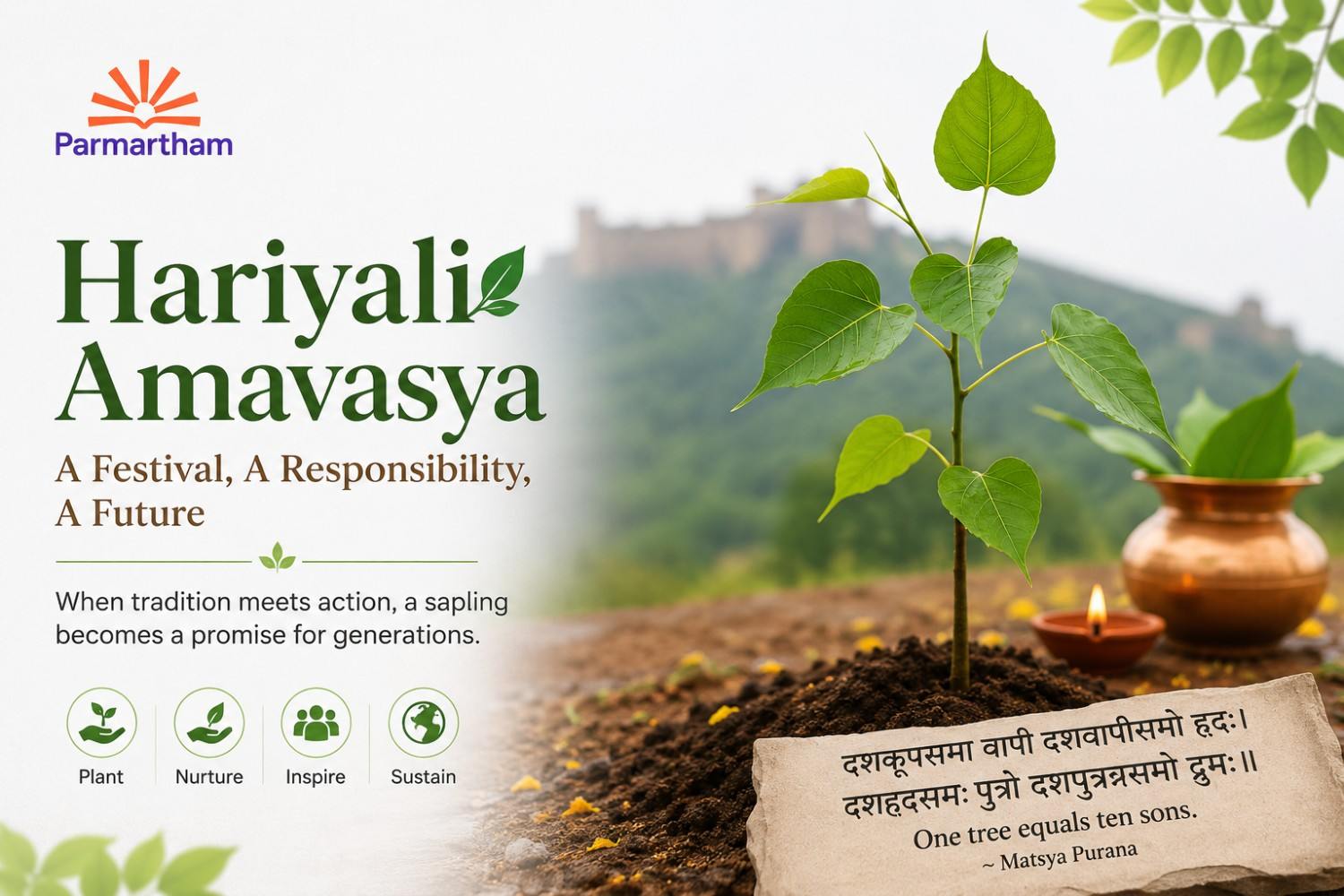
Our students left the hostel early on the morning of 12 August 2026. Forty of them, their warden and the programme team, with the day's meals packed in the hostel kitchen and carried along with the water and the rest of the supplies, so that nobody would have to cut the morning short for want of anything.
They were going to Kishan Bagh, the desert park that sits below the Nahargarh hills on the edge of Jaipur. It was Hariyali Amavasya.
We could have marked the day inside the hostel. A sapling in the courtyard, a photograph for the records, a short talk about the environment, and the whole thing finished by ten in the morning. We decided instead to spend the day the way the festival was meant to be spent, outdoors, with the students standing in front of the thing everyone was talking about.
Hariyali Amavasya falls on the new moon of Shravan, at the point in the year when the first rains have gone into the soil and the land turns green again. Across Rajasthan, Madhya Pradesh and Gujarat it is kept as a festival of greenery. The name says plainly what it means. Hariyali is the green that comes back.
Through Shravan, water is offered to Lord Shiva. On this day people gather at the peepal, complete a parikrama, and light a lamp at its roots. Being an amavasya, it belongs to the ancestors as well, marked by tarpan and by the giving of grain, food and clothing to those who need it. In the villages the farmers bring out their seed and their implements and worship them before sowing begins, because the whole year now rests on the weeks that follow.
Swings go up under the older trees. Women sing the Sawan songs. Ghewar and malpua come out of kitchens that can manage them. Jaipur keeps the day in its own way, with the fair at Ramniwas Bagh running across two days and the second day reserved by tradition for women. In Mathura and Vrindavan, the hindola darshan opens on the same date.
Underneath all of it sits the one act the day exists for. A tree goes into the ground, and somebody takes responsibility for keeping it alive.
For many of our students this is not a distant custom. They come from families that farm, or that farmed until recently. They have watched their grandmothers tie a thread around a peepal. Some of them have carried water to a sapling in the family field. The festival is already in them. What the day at Kishan Bagh added was a second way of understanding it.
Long before ecology arrived in a school syllabus, our texts had settled the worth of a tree in words that leave no room for argument.
दशकूपसमा वापी दशवापीसमो ह्रदः।
दशह्रदसमः पुत्रो दशपुत्रसमो द्रुमः॥
Ten wells equal one pond, ten ponds equal one lake, ten lakes equal one son, and one tree equals ten sons.
~ Matsya Purana
Read that line again and notice what it does. In a society that kept a son at the centre of the household, the tree was placed above him, because the tree outlives the family and gives shade to everyone who passes under it, including people the family will never meet.
The peepal, worshipped on this day in villages right across Rajasthan, is given the first place among trees in the Bhagavad Gita.
अश्वत्थः सर्ववृक्षाणां देवर्षीणां च नारदः।
गन्धर्वाणां चित्ररथः सिद्धानां कपिलो मुनिः॥
Among all trees I am the ashvattha, among the divine sages Narada, among the gandharvas Chitraratha, and among the perfected ones the sage Kapila.
~ Bhagavad Gita 10.26
The prayer said at the foot of the peepal treats the tree as a form of the divine from root to crown.
मूलतो ब्रह्मरूपाय मध्यतो विष्णुरूपिणे।
अग्रतः शिवरूपाय वृक्षराजाय ते नमः॥
Salutations to you, king among trees, who is Brahma at the root, Vishnu at the middle and Shiva at the crown.
~ Traditional peepal vandana
Elsewhere the guidance stops being poetic and becomes a list, with species and quantities named.
अश्वत्थमेकं पिचुमन्दमेकं न्यग्रोधमेकं दश चिञ्चिणीकान्।
कपित्थबिल्वामलकत्रयं च पञ्चाम्रवापी नरकं न पश्येत्॥
One who plants one peepal, one neem, one banyan, ten tamarind, three each of wood apple, bael and amla, and five mango trees will never see hell.
~ Varaha Purana
And the relationship the festival asks every generation to take up again is put in the Atharvaveda in a single line.
माता भूमिः पुत्रोऽहं पृथिव्याः।
The Earth is my mother, and I am her child.
~ Atharvaveda 12.1.12
For a child living in a hostel, far from the field their family works, these verses can sit on a page and stay there. We took them outdoors to see whether they would come off it.
Most of our students are the first in their families to reach this stage of schooling. They study photosynthesis, transpiration and adaptation for their board examinations, and they answer questions on all three correctly, because they work hard and because we push them.
What almost none of them have had is a morning in which those words attach themselves to a living plant standing an arm's length away.
That gap is quiet, and it costs a great deal. A definition that has only been memorised comes out cleanly in an examination hall and is gone by the next winter. A definition that has been seen solving a real problem in front of a student tends to stay for good. Our science teachers have watched both outcomes for years, and this visit was planned around what they told us.
So we treated the day as a study visit, and we chose the site on that basis.
This year Parmartham marked Hariyali Amavasya by putting its students in front of the environment itself, and by giving them the whole morning to look at it properly.
The hostel kitchen packed the meals the previous night. Water, first aid and the day’s supplies went with the group. The warden travelled with the students and stayed with them throughout, and attendance was taken at the gate and again at every point where the groups came back together.
Inside the park, the forty students were split into small clusters, each with a member of the team. That decision mattered. In a group of forty, six students see the specimen and thirty four see the backs of their classmates. In a group of eight, every student gets to the front, looks closely, points at something and asks the question they actually had.
Kishan Bagh was chosen with care.
The site lies at the foot of the Nahargarh hills, and for years it was a stretch of eroding, degraded sand dunes at the edge of the city. It was restored into a desert park that now holds the arid ecosystem of Rajasthan inside one walkable landscape, with native desert species growing beside exposed Aravalli rock. The Aravallis are among the oldest mountain systems on earth, and the stone standing at Kishan Bagh belongs to that record.
There is a Vedic line that fits this place better than any description we could write.
यत् ते भूमे विखनामि क्षिप्रं तदपि रोहतु।
मा ते मर्म विमृग्वरि मा ते हृदयमर्पिपम्॥
O Earth, whatever I dig out of you, may it grow again quickly. May I not injure your vital parts, nor your heart.
~ Atharvaveda 12.1.35
Kishan Bagh is that verse carried out in practice. Land that was damaged has been brought back. Our students walked through the result, and the point was not lost on them.
The morning went on the same question, asked again and again in different forms. How does a plant stay alive here on this little water?
They studied the khejri, the state tree of Rajasthan, which sends a taproot far below the surface after moisture and, being a legume, puts nitrogen back into the soil around it. Several of the students already knew that a khejri is left standing in the middle of a ploughed field across western Rajasthan. Their families do it. What they had not been told is why the crop does better around it. On Wednesday morning they were given the biology behind a practice they had grown up watching, and you could see the moment it landed.
They examined the kair, which carries almost no leaves and photosynthesises through its green stems, holding water loss down to the minimum it can manage. They looked at thorns that are leaves in another form, at waxy and hairy leaf surfaces built to keep moisture in, at reduced leaf area, at succulent tissue storing water for the months when there is none, and at the phog with its roots gripping loose sand and holding a dune against the wind.
The rohida, the state flower of Rajasthan, showed them a plant timing its flowering to a short and unreliable window of rain.
Then the team turned their attention to everything living off those plants. The insects working a flowering branch. The birds in the canopy. The drop in temperature under a single tree, which the students could feel on their own skin after an hour in the open. Adaptation stopped being a chapter heading and turned into a set of working solutions they could put a finger on.
By the time the group sat down to eat, the students could explain in their own words why a khejri is still standing at the end of a Rajasthan summer.
What our students wrote in their notebooks at Kishan Bagh is what the festival has been saying for centuries.
A tree holds water. A tree holds soil. A tree feeds the ground it stands on and shelters everything living around it. The Matsya Purana put it in a comparison any farming household would understand in one hearing. Plant physiology puts it in root depth, transpiration rate and nitrogen fixation. Both arrive at the same place, and a student who has met the two of them will stand up for a tree with reasons of their own.
This is what observing a festival in the field is worth. Hariyali Amavasya asks for a tree to be planted. A student who knows what that tree will be doing for the next sixty years plants it with intent, waters it in the second year, and notices when it dies.
Parmartham works with students who have real ability and have had very little exposure to draw on. Our classrooms, our mentors and our academic support carry them through their examinations. A day like this one does work of a different kind.
A student who has stood under a khejri and understood how it holds the soil together looks at trees differently for the rest of their life. That change is permanent, and it costs one morning.
We intend to keep these visits on the calendar through the year, so that the students in our care grow up able to read the natural world as closely as they read their syllabus. In our experience, environmental awareness is built by standing a child in front of a living thing and handing them the language to understand it.
Forty students came back to the hostel that afternoon with that language. Their notebooks have the diagrams. The photographs have the rest.
Also Read: When Summer Heat Teaches Kindness: Parmartham Students Are Becoming Guardians of the Smallest Lives
Parmartham (Ramesh Shiksha Foundation) is a Jaipur based Section 8 organisation working in education, mentorship and skill development for students and women from underserved communities. Our programmes bring together academic support, residential facilities, mentorship and skill training, and are built to carry a student from the classroom through to a livelihood.
If you would like to support this work, partner with us, or simply know more about what we do:
Email: info@parmartham.org.in
Phone: 8302883596
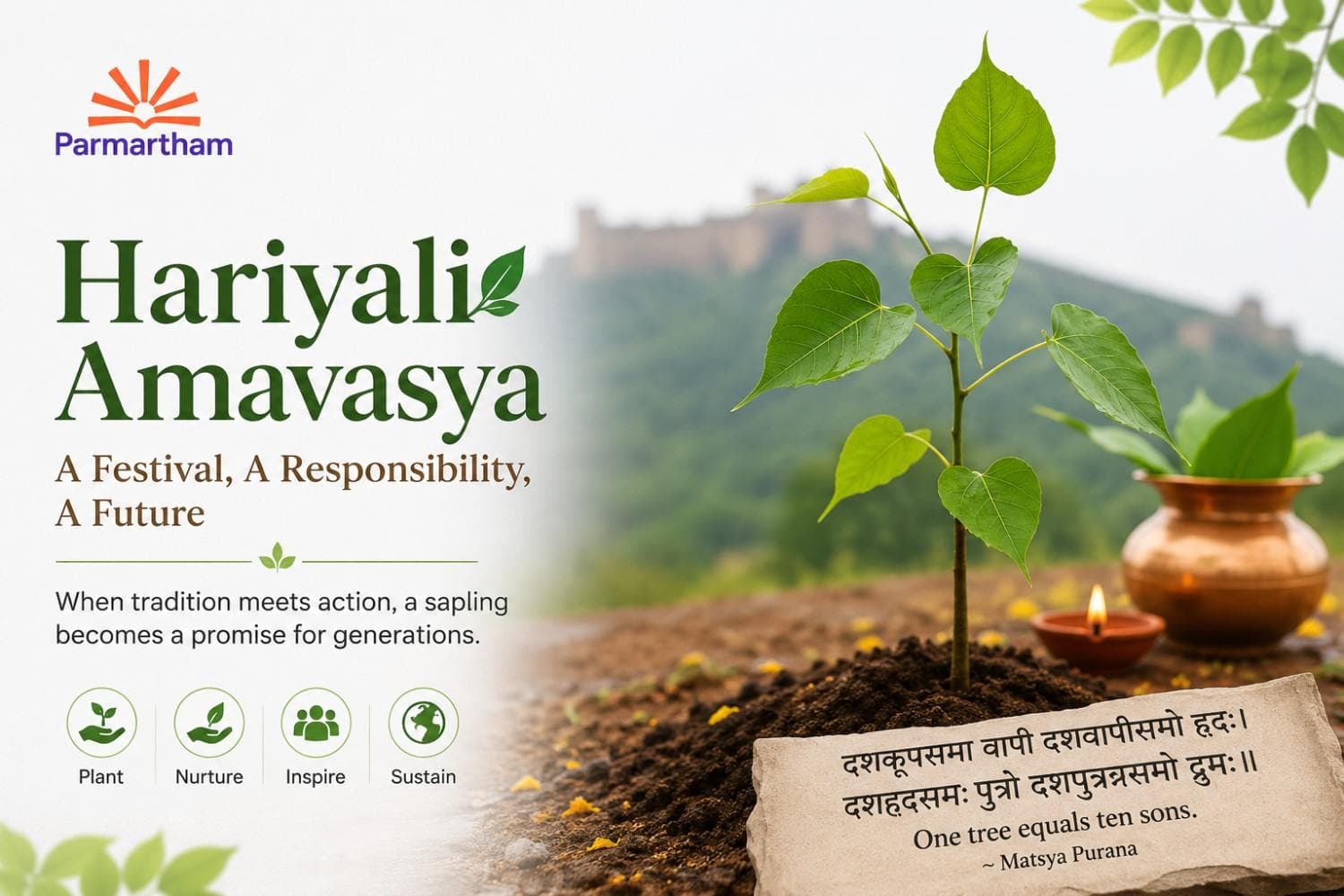
Discover how 40 hostel students explored Jaipur's Kishan Bagh on Hariyali Amavasya, linking ancient traditions of tree worship with real-world science.

Discover how Parmartham celebrated International Yoga Day in Jaipur, promoting yoga, mindfulness, and holistic education for students and communities.
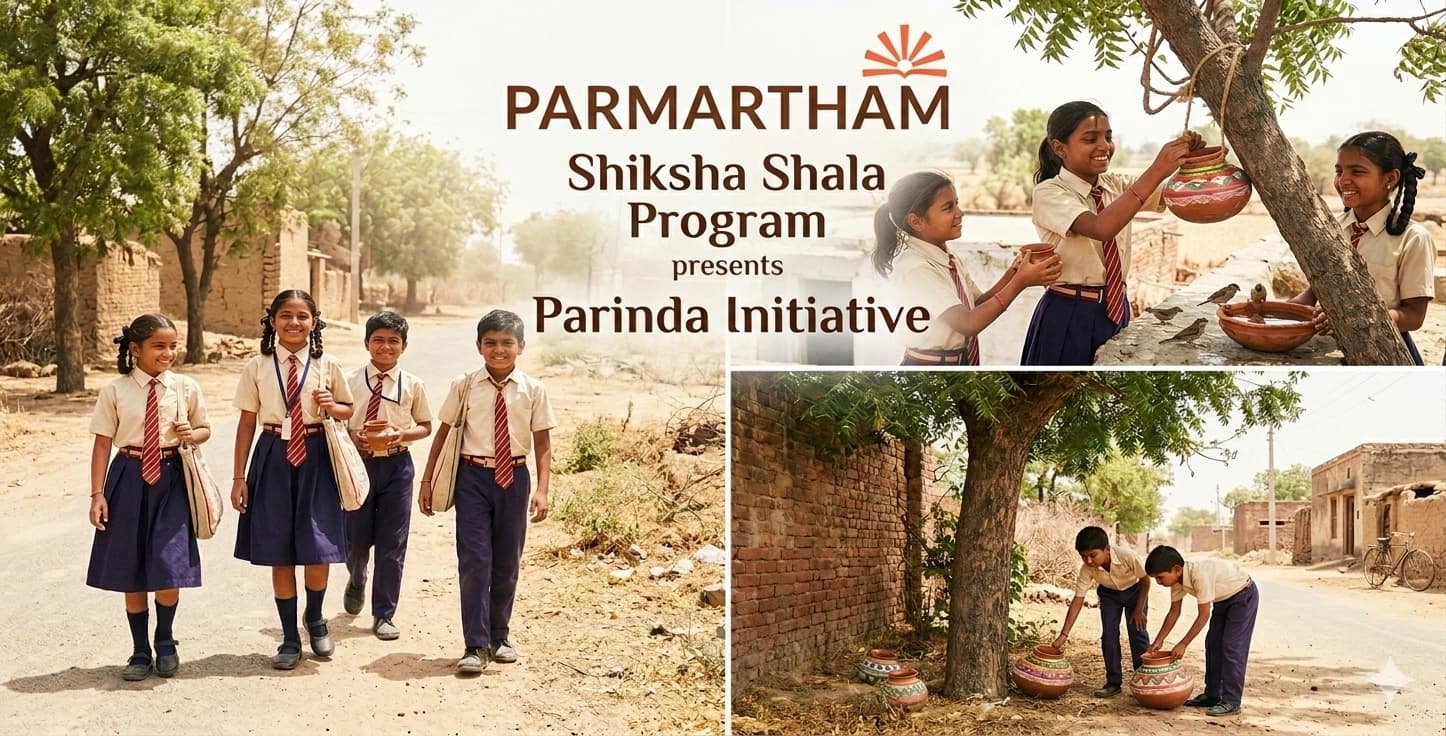
This inspiring story shows how small acts of kindness by Parmartham students are helping birds survive the intense Nau Tappa heatwave in India.

Kaushal Vikas Program by Parmartham in Jaipur offers skill training, internships, and placement support to help youth gain job-ready skills and build careers.